Learning to read music has never been easier or more fun. Created in 1999, Happy Note! offers videos and even games to help you quickly and easily learn to read notes in the treble clef and bass clef, with the help of sound and colored notes.
Do Beginners Need to Know Music Theory to Read Notes?
NO, Not at all!
Our videos and games are designed so you can start learning to read music notes immediately, no theory required.
A fun alternative to our other videos for learning to read notes while playing! Versions with A H C and Do Re Mi… Si/Ti available.
However, if you’re curious about the building blocks of sheet music, these core concepts will help you understand how it all works:
- The Music Staff: The 5 lines and 4 spaces where notes are written.
- Music Clefs: The symbols (like Treble or Bass clef) that tell you which note is on each line.
- Music Notes Names: The different systems for naming the notes, such as A, B, C or Do, Re, Mi.
Find the Right Video in 1 Minute!
Before you start learning to read your first notes with the help of sound and color, you need to choose:
- your notation (A B C or Do re Mi)
- your clef (treble of bass)
- your speed (slow, walking pace, moderate speed)
A B C or Do Re Mi? Music Notation Depends on Your Country
First, choose the note naming system that works best for you:
A B/H C D E F G
or
Do Re Mi Fa Sol La Si/Ti.
- Choose the alphabetical A B C D E F G system if you live in an English-speaking country or plan to play jazz.
- Choose the A H C D E F G system where H replaces B if you live in Germany, Poland, or a Scandinavian country.
- Choose Do Re Mi Fa Sol La Si if you live in a country that uses fixed-do solfège (Do = C) — a system developed near Venice in Italy by the monk Guido d’Arezzo — or if you want to learn the Norwich sol-fa system invented by Sarah Anna Glover, where “Si” was changed to “Ti” to give each syllable a unique initial letter.
Not sure which musical notation is used where you live? Learn more about note names in different countries.
Treble or Bass Clef? The Right One Depends on Your Instrument or Vocal Range
The Treble Clef is used with the sheet music for:
- Violin
- Cello
- Guitar
- Mandolin
- Harp
- Harpsichord
- Piano
- Clarinet
- Oboe
- English horn
- Organ
- Accordion
- Saxophone
- Trumpet
- Flute
- French horn
And for vocalists, with the voice parts of:
- Tenor
- Soprano
- Contralto
- Alto
- Mezzo-soprano
The Bass Clef is used with the sheet music for:
- Piano
- Harpsichord
- Organ
- Harp
- Cello
- Double bass
- Trombone
- Bassoon
- Contrabassoon
- Tuba
- Guitar
- Bass guitar
And for vocalists, with the voice parts of:
- Bass
- Baritone
Some music instruments, like the piano, require reading both clefs: treble clef for the right hand and bass clef for the left.
Note: The viola uses the C clef placed on the 3rd line. – Learn more about music clefs.
Video Speed (Adagio, Andante, Moderato)
Most videos designed to help you learn to read music are available at three speeds: Adagio, Andante, and Moderato. Choose the speed that fits your skill level, whether you’re a beginner or want to improve your reading.
If you’re unsure which speed to pick, we recommend starting with Adagio (slow).
Choose Your Video
Now you know enough to choose the right video.
As a reminder, Adagio = slow, Andante = walking pace, Moderato = moderate speed.
Treble Clef (G Clef)
- Treble Clef, A H C, Adagio (German notation)
- Treble Clef, A H C, Andante (German notation)
Bass Clef (F Clef)
Full Playlist
Piano and Keyboards (Harpsichord, Organ, Synthesizer…)
If your instrument is a piano or another type of keyboard, you need to learn to read the treble clef – for the right hand – and the bass clef – for the left hand.
Happy Note! offers videos specifically dedicated to helping you learn how to read piano sheet music. Each new note you learn to read is shown on the corresponding key of an 88-key keyboard.
Reading Notes on Piano Sheet Music
Follow the link above to choose between right and left hand, and between A B C and Do Re Mi notation.
Learning to read music while having fun, it’s possible
If you are on Windows and prefer a more entertaining approach, you can use our video games.
Tetris Music Notes HN
Tetris Music Notes HN is a free educational music game where musical notes fall from the treble clef: you must guide them to their name (C D E F G A B) while avoiding the dynamite (optional) moving around your screen during the game!
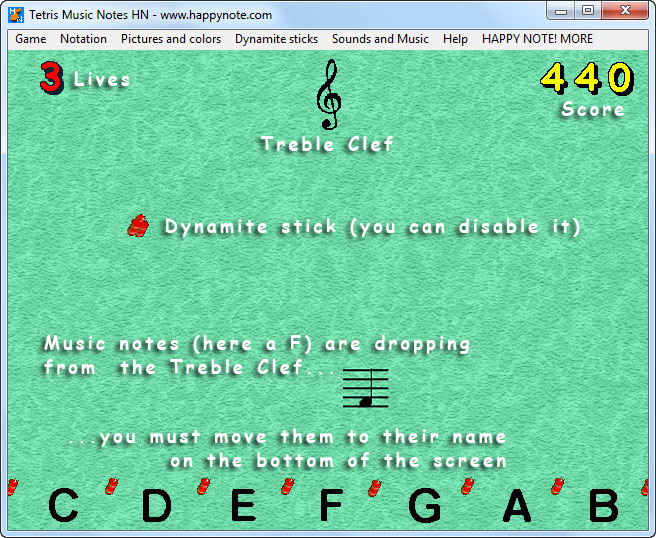
Tetris Music Notes HN is limited to 8 treble clef notes. To learn more notes in both treble and bass clef, use Treble and Bass Clef Sheet Music HN.
Sheet Music Treble Clef and Bass Clef HN
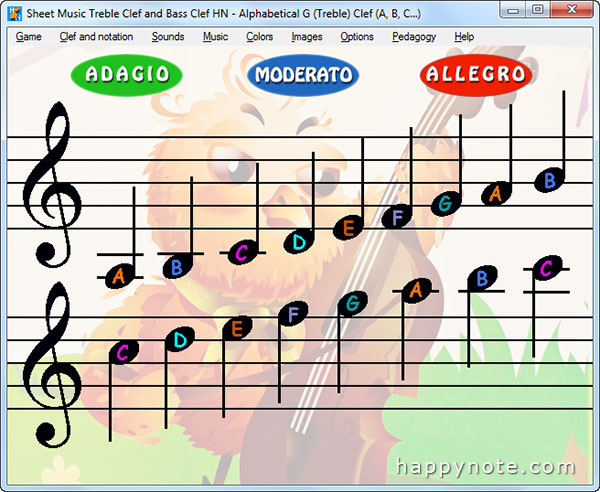
If you’re on a Windows computer, try the Sheet Music Treble Clef and Bass Clef HN game. It lets you choose between the Do Re Mi and A B C notation systems, and even the German one using H instead of B.
Frequently Asked Questions
Do you need to already know solfège or music theory to learn to read music?
No: as stated at the top of the page, no musical knowledge is needed to learn to read notes. Forget solfège and music theory, there’s nothing to know or understand, you just need to be able to immediately recognize a note according to its position on the staff – the five horizontal lines and four spaces – and the clef placed at the beginning of that staff.
Do you need to already have an instrument to learn to read notes?
No, absolutely not. In fact, ideally you should already know how to read notes before starting to learn to play an instrument.
Why? Because learning an instrument requires your full attention. If you also have to struggle to read notes, you risk being overwhelmed by the size of the task at hand.
The issue is more psychological: learning to read notes “in a vacuum” can be tedious and not very motivating. You need to try to find a balance so that your reading level always stays a little ahead of your progress on the instrument.
Is knowing how to recognize notes the same as knowing how to read them?
This is absolutely NOT the same thing!
Recognizing a note: This means applying a laborious method – counting lines, using mnemonic devices – to painstakingly work out the name of a note.
Reading a note: This means seeing its position on the staff and immediately knowing its name, without thinking.
There are plenty of “miracle recipes” for recognizing notes, but there is only one method for truly LEARNING to read them: you need to practice regularly. A little, but regularly.
When you truly know how to read notes, it’s like reading a book – you no longer decode each letter, you read words, whole sentences. Music reading becomes instant, natural, and this skill stays with you FOR LIFE.
Our method gives you the tools to transform laborious recognition into instinctive reading through regular practice.
How long should you practice daily?
The key is not duration but consistency.
Practicing for an hour and then waiting several days is far less effective than practicing a few minutes every day.
The optimal method:
- 5 minutes, 1 to 2 times a day (twice being ideal)
- Every day without exception
- 10 minutes a day is better than one hour a week
This consistency allows your brain to permanently anchor the relationship between the position of notes and their names.
Should you learn to read the treble and bass clefs at the same time?
For instruments that require the use of two clefs, especially those that use two clefs simultaneously – piano, harpsichord, organ, harp… – learning to read the treble and bass clefs at the same time offers many advantages:
- A complete view of the music: You immediately learn to see the score as a single, unified whole. Your mind maps the entire musical spectrum from low to high, without splitting it into two separate parts.
- Middle C as a reference point: By studying both clefs together (grand staff), you come to understand that Middle C is the bridge connecting them. This greatly simplifies finding your way around the score.
- No “lag” on the bass clef: Starting out by learning to read music only in the treble clef often creates an imbalance. Later on, you have to make an effort to catch up on the bass clef. The simultaneous approach ensures a perfectly symmetrical and balanced learning of music reading right from the start.
In short: learn to read music in the treble and bass clefs together, to build a faster and more solid reading foundation.
What are the unique advantages of Happy Note! videos for learning to read music?
Happy Note! videos not only teach you to read notes quickly, but also help you develop your musical ear and sense of tempo – elements that are usually taught separately in conventional music reading instruction.
- Intuitive ear recognition – By playing the sound of each note as you read it, Happy Note! videos train your ear to naturally memorize the pitch of each note.
- Tempo mastery – The videos maintain a perfectly steady tempo, training you to read notes without slowing down or speeding up, an essential skill for playing alone and indispensable for playing with other musicians.
- Immediate self-correction – Note names are always displayed, letting you instantly check your reading and progress independently
- Improved reading speed – Thanks to the different speeds available (Adagio, Andante, Moderato), you can progress at your own pace. Two new speeds, Largo (very slow) and Allegro (fast), are in the works. Subscribe to the Happy Note! YouTube channel to be notified of daily updates.
Why does Happy Note! use colored notes when sheet music is written in black and white?
From 2 to 17 notes, Happy Note! videos and the Treble and Bass Clef Sheet Music HN game offer a progressive approach to learning music reading: just two notes to start, then you add a third note, then a fourth, and so on.
Colored notes are used only to help you recognize new notes. Once a note is no longer new, the color is removed.
Whether for the Treble and Bass Clef Sheet Music HN game or for the videos, there are never two different notes in color at the same time.
Is knowing how to read notes enough to sight-read a score?
Knowing how to read notes is the essential foundation. You need to complement it with knowledge of other musical symbols:
- Note values and their durations – whole note, half note, quarter note, eighth note – which determine the rhythm and musical pulse
- Musical rests – whole rest, half rest, quarter rest – just as important as the notes themselves in the rhythmic structure
- Accidentals – sharp, flat, natural – which alter the pitch of notes by lowering or raising them a chromatic half step
- Meter and tempo – which organize the musical flow over time