Chopin’s Berceuse, Op. 57, is a lullaby to be played on the piano. He composed it in 1843/44 as variations in D-flat major. Frédéric Chopin originally called his work Variantes.
Prokofiev’s Piano Concerto No. 3 in C major, Op 26, was completed in 1921. Sergei Prokofiev began his work on the concerto as early as 1913 when he wrote a theme with variations which he then set aside.
Sergei Prokofiev set to work on his Piano Concerto No. 2 in 1912 and completed it in 1913. But that version of the concerto is lost; the score was destroyed in a fire following the Russian Revolution.
The Overture in the French style, BWV 831, original title Ouvertüre nach Französischer Art, also known as the French Overture and published as the second half of Clavier-Übung II in …
Beethoven’s Piano Concerto No 4 in G major, Op. 58, was composed in 1805–1806. Ludwig van Beethoven was the soloist in the public premiere as part of the concert on 22 December 1808 at Vienna’s Theater an der Wien.
Edvard Grieg composed the Cello Sonata in 1882–83, marking a return to composition following a period when he had been preoccupied with his conducting duties at the Bergen Symphony Orchestra as well as illness.
Beethoven’s Piano Sonata No 28 in A major, Op. 101, was written in 1816 and was dedicated to the pianist Baroness Dorothea Ertmann, née Graumen. This sonata marks the beginning of what is generally regarded as Ludwig van Beethoven’s final period.
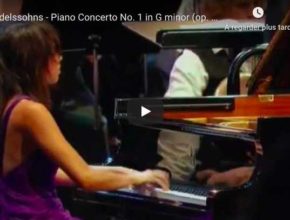
Mendelssohn’s Piano Concerto No. 1 was written in 1830–31, around the same time as his fourth symphony (“Italian”), and premiered in Munich in October 1831. This concerto was composed in Rome during a travel in Italy after the composer met a pianist in Munich.
La campanella (Italian for The little bell) is the nickname given to the third of Franz Liszt‘s Six Grandes études de Paganini, S. 141 (1851). It is in the key …